
Documenting the Unseen: A New Field Manual for Conflict-Related Sexual Violence in Darfur and Beyond

Updated: Dec 30, 2025

Conflict has persisted in Darfur and other regions of Sudan for more than two decades. The eruption of the current all-out civil war since April 2023 has engulfed the country, resulting in widespread violence, displacement, and suffering. Conflict-related sexual violence (CRSV) is a pervasive and systematic aspect of this violence, frequently under-documented and occurring in the shadows of broader atrocities.
Documenting CRSV in these contexts is highly challenging. Survivors face profound stigma, personal risk, and psychological trauma when sharing their experiences, while opportunities to pursue justice remain severely constrained due to systemic neglect and discrimination within the justice system.
The all-out war since April 2023 has deprived survivors of access to justice within Sudan, leaving documentation efforts largely to human rights defenders and international mechanisms such as the United Nations Fact-Finding Mission and the International Criminal Court. Currently, the ICC’s mandate formally covers the Darfur Situation; however, we argue that that its jurisdiction can be interpreted to extend to the rest of Sudan.
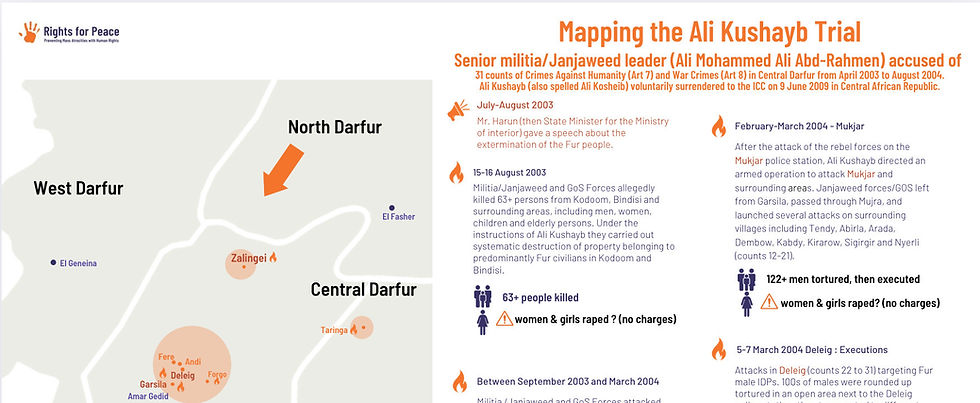
The recent conviction in The Prosecutor v. Ali Muhammad Ali Abd-Al-Rahman , commonly knownas Ali Kushayb, represents a historic milestone for accountability in Darfur. In October 2025, the ICC handed down its first conviction in the Darfur situation, finding Kushayb guilty of 27 counts of war crimes and crimes against humanity committed during the 2003-4 conflict, including rape and other forms of sexual violence as part of a campaign of persecution.
While this decision represents "a good start for accountability", it also underscores the enormity of the challenge: decades of evidence-gathering, limited convictions and most importantly, countless suspects still at large, with some still perpetrating atrocities in Sudan. Sudanese activists say that the current conflict is fueled by the blatant impunity for the atrocities of the Darfur genocide in 2003-4.
Against this backdrop Rights for Peace is proud to release its third field Manual in a series of training guides designed to support human rights defenders, funded by the Matrix Causes Fund.
Building on our previous manual on Documenting Identity-Based Violence, which provides guidance on gathering evidence on establishing the legal elements required for genocide, incitement to genocide and persecution, this new manual focuses on the specific demands of CRSV documentation in complex conflict settings-
This Manual is process-oriented, offering step-by-step practical guidance on survivor-centred approaches to documentation. It unpacks victims' rights, basic elements of trauma, ethical risk assessment, informed consent, trauma-sensitive interviewing, and secure information handling — all essential elements in collecting credible, respectful documentation in situations where survivors and human rights defenders take risks to gather information and establish facts with limited support.
The Manual complements a growing body of practice-oriented resources designed to support the application of the Murad Code, a global framework that sets out ethical, survivor-driven principles for collecting information on conflict-related sexual violence in a manner that promotes dignity and agency.

By grounding its approach in survivor agency and victims' rights to access justice, the manual aims not only to improve the quality of documentation but also to empower survivors as rights holders in their pursuit of justice. In contexts such as Darfur, where only a small number of perpetrators have been held to account, practical tools that guide safe, ethical documentation are urgently needed.
The Manual is also available in Arabic.

Comments