
Listen to Radio Miraya 101 FM series on transitional justice in South Sudan
Updated: Apr 21
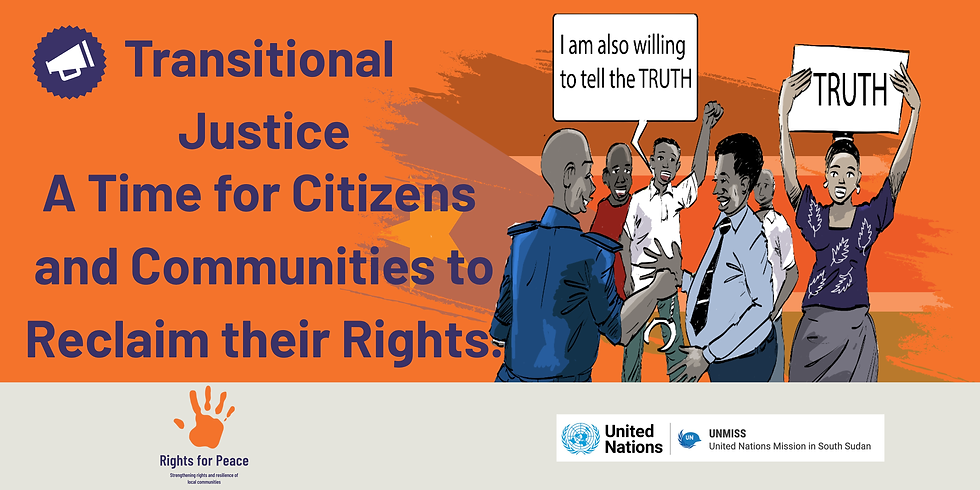
As part of our work supporting transitional justice in South Sudan, Rights for Peace has been coordinating a radio talk show on transitional justice, with UN Radio Miraya FM. In a fragile climate of peace, the programme, running from December 2025 to April 2026, supports public engagement on the establishment of the Commission for Truth, Reconciliation and Healing (CTRH) and the Compensation and Reparations Authority (CRA) established by law in November 2024.
Citizens have been able to call in and ask questions, engaging with experts from diverse backgrounds. Key transitional-justice issues covered include how the Commission for Truth, Reconciliation and Healing might function in practice, issues around truth-telling, amnesties, protection of victims and witnesses, as well as reparations, and the inclusion of women, children and other vulnerable groups in the process.
The security situation in South Sudan has been volatile, with sporadic violence erupting in some regions, so the task of establishing transitional justice mechanisms amidst insecurity and calls for elections is significant. Members of the public have protection concerns, raising questions about a general lack of accountability and weak institutions and the government's commitment to transitional justice.
“In this country, we have high-profile individuals from both sides of the political divide who have been sanctioned by the international community and accused of war crimes and crimes against humanity. They are either perpetrators or funders of violence. Can the CTRH use those international reports to summon individuals to come and tell the truth?” Caller from JubaThese concerns are coupled with diminishing support from international donors as challenges. Financing of reparation and the role of the Compensation and Reparation Authority were raised in this context, as seen by this caller:
“The government has failed to compensate the communities that are suffering from oil pollution from the oil-producing areas. Where will the government get the money to compensate over one million people who are victims of the war?” Can the CTRH start its work with recovering the land and houses of those who are in the PoC [Protection of Civilian sites]? What will the commission do to ensure that the houses are given back to their rightful owners? Caller from MalakalThe guest speakers on this program are experts selected from civil society organisations, UN agencies, international organisations and researchers locally and from across the region.
Date | Topic | Speaker |
|---|---|---|
16 Dec 2025 | What is transitional justice? | Managing Director, Detcro |
27 Jan 2026 | The Commission for Truth, Reconciliation and Healing (CTRH Act 2024) | Former Executive Secretary, Truth Commission, The Gambia |
10 Feb 2026 | Truth-seeking | Dr. Baba Jallow former Executive Secretary, Truth Commission, The Gambia |
17 Feb 2026 | Women, children and vulnerable groups in the justice process | Executive Director, Rights for Peace |
24 Feb 2026 | The Compensation and Reparations Authority (CRA) Act 2024 | Chairperson of the South SudanTransitional Justice Working Group |
10 Mar 2026 | Protection of victims and witnesses: safety, confidentiality, dignity and respect | Transitional Justice Advisor, UN-HRCSS |
24 Mar 2026 | The role of the media in post-conflict transition | Dr. Baba Jallow former Executive Secretary, Truth Commission, The Gambia |
31 Mar 2026 | Amnesty, accountability and command responsibility | Commissioner, UN Human Rights Commission South Sudan |
07 April 2026 | What role can the public play? | Regional Director, International Centre for Transitional Justice |
21 Apr 2026 | Challenges in implementing transitional justice: policy vs practice | Dr. Baba Jallow former Executive Secretary, Truth Commission, The Gambia |
5 May 2026 | Land, loss and displacement: the way forward | Ruben Carranza, Senior Expert Programs, ICTJ |
12 May 2026 | Prevention mechanisms and institutional reforms | Executive Director, Rights for Peace |
Link to Radio Miraya FM in South Sudan to listen live from 5-6 pm local time.

In collaboration with UN Radio Miraya 101 FM, South Sudan

David Deng is the Managing Director of Detcro, a South Sudanese research and advocacy firm focused on peacebuilding, governance, and human rights. He has worked in South Sudan since 2010, conducting research on land law and policy, transitional justice, and citizen perceptions of peace processes.
Dr. Baba Jallow is former Executive Secretary of Gambia’s Truth, Reconciliation and Reparations Commission (TRRC), a position he held from February 2018 to February 2022. He received his Masters in Liberal Studies from Rutgers University, Camden (2005) and his Ph. D in African History from the University of California at Davis (2011). His research interests include the history of colonial and post-colonial Africa, transitional justice and truth commissions, and negotiation and conflict resolution. Prior to his appointment as Executive Secretary of the TRRC, Dr. Jallow taught African history at Creighton University in Omaha, Nebraska and La Salle University in Philadelphia, Pennsylvania. From July 2023 to June 2024, Dr. Jallow served as the Inaugural Roger D. Fisher Fellow in Negotiation and Conflict Resolution at Harvard Law School. Dr. Jallow is a member and current Chair of the African Union’s Continental Reference Group on Transitional Justice in Africa.
Mr. Lony Ruot Kok holds Associate Degree in Law, LLB pending graduation and has more than 15 years working experiences and obtained further training skills in education, public administration, management, peacebuilding, human rights and other fields. He is appointed President and Secretary of the Board of Standard Action Liaison Force (SALF). Mr. Kok also serves in the Board of different civil society organizations working in South Sudan and the other regions of the world; these including and not limited to Human Rights Documentation Initiative (HRDI), South Sudanese Network for Democracy and Elections (SSuNDE), East and Horn of Africa Election Observers Network (EHORN) and Global Network of Domestic Election Monitors (GNDEM) among many other. He is the current chairperson of the South Sudan Transitional Justice Working Group (TJWG).
Christine Alai is a human rights lawyer who has dedicated her almost 20-year career to championing access to justice for victims of gross human rights violations and atrocity crimes. Christine presently serves as the Transitional Justice Advisor to the United Nations Commission on Human Rights in South Sudan. Christine has led and contributed to numerous litigation, research, policy and legislative development, and advocacy initiatives that have led to significant advancements in human rights and transitional justice in Kenya, South Sudan, and parts of East and Central Africa. Christine has specialized expertise on advancing survivor centered prevention and response to sexual and gender-based violence, especially in conflict and emergency contexts. Christine also serves as the Chairperson of the International Commission of Jurists-Kenya, and Co-founder of Utu Wetu Trust – a think tank that focuses on enhancing gender justice in Africa, among other roles.
Agatha Ndonga has over a decade of experience in transitional justice, peacebuilding, gender and human rights, legal and policy reform, and international relations. Agatha provides technical expertise to government and non-government/civil society actors including victims’ and survivors’ networks, on inclusive implementation of transitional justice processes aimed at preventing the recurrence of human rights violations.
She currently manages the South Sudan Program at International Center for Transitional Justice (ICTJ), where she leads the conceptualization, design, implementation, monitoring, and evaluation of initiatives supporting innovative approaches to transitional justice under the 2018 Revitalized Peace Agreement.
Her recent publications examine the complementary role of customary and informal justice mechanisms within the broader peacebuilding and reconciliation efforts in contexts affected by mass human rights violations - https://www.ictj.org/reconciliation-through-customary-justice-southsudan as well as the inclusion of conflict-related displaced populations in transitional justice policymaking - https://www.ictj.org/inclusion-displaced-persons-south-sudan’s.
Agatha has served as a Fellow with Robert Bosch Stiftung, Institute for Justice and Reconciliation, and The Hague Institute for Global Justice. She holds an M.A. in Peace Studies and International Relations from the Hekima University Institute for Peace Studies and International Relations – an affiliate college of the Catholic University of Eastern Africa.

Comments