
Conflict-related sexual violence is not inevitable: survivors' views on prevention in Sudan
Updated: Jul 9
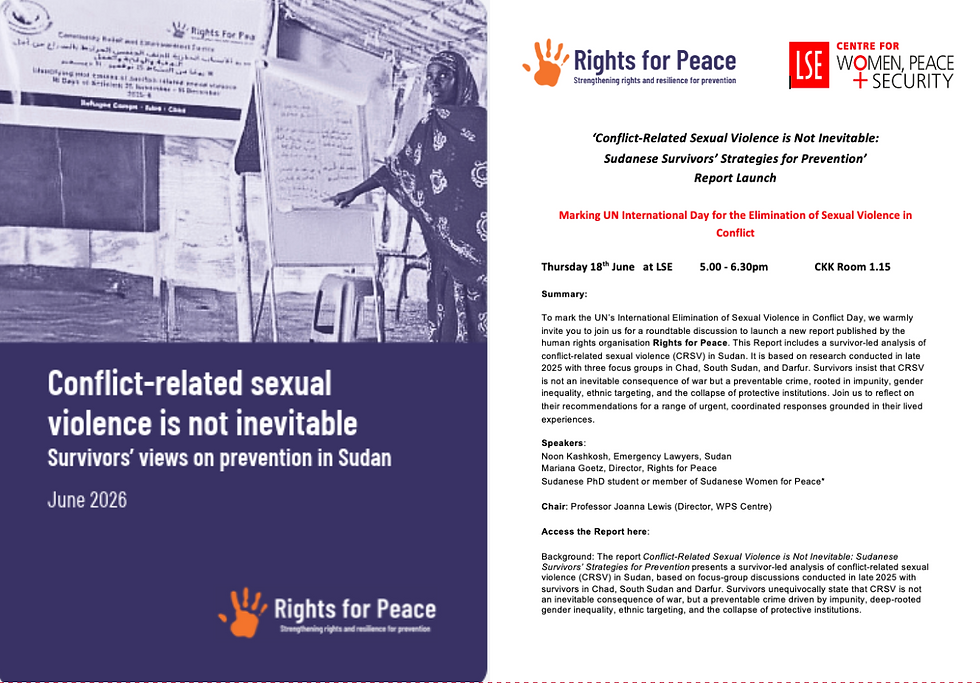
19 June marks the International Day for the Elimination of Sexual Violence in Conflict, and we are commemorating it with the launch of a new report, “Conflict‑related sexual violence is not inevitable: Survivors’ Views on Prevention in Sudan.” The report presents a survivor‑led analysis of the causes and drivers of conflict‑related sexual violence (CRSV) in Sudan, based on focus‑group discussions conducted in late 2025 with survivors in Chad, South Sudan and Darfur. Survivors unequivocally state that CRSV is not an inevitable consequence of war, but a preventable crime driven by impunity, deep‑rooted gender inequality, ethnic targeting, and the collapse of protective institutions. Their views and perceptions are insightful and provide a range of recommendations for prevention. The report is available here.
In Sudan, three years of renewed war have placed an estimated 6.7 million women and girls at risk of gender-based violence. Conflict-related sexual violence (CRSV) is "made to seem normal, especially against women and girls", according to one survivor who took part in the focus group discussions. “In my community, anything that happens to a woman is considered a disgrace and is tied to the family’s honour”, explains another. One participant powerfully reflects: “silence protects the violence, not the survivor.”
The report reflects survivors' lived experiences and identifies prevention strategies that include structural measures as well as community‑based approaches:
"Sexual violence increases where there is no rule of law and no accountability."
This year's International Day for the Elimination of Sexual Violence in Conflict focuses on the children who suffer these terrible crimes. Our report highlights the experiences of children born of CRSV and the social stigma suffered both by them and their mothers:
"A child born of rape is viewed as a criminal who will inherit his father's genes in the future ... a child of the enemy"
Survivors consistently emphasise that prevention of CRSV is possible, but needs dedicated and coordinated strategies that strengthen accountability mechanisms, invest in women's empowerment, address social norms and role models for youth, and improve the coordination and quality of public services that protect and support victims. In the community, targeting vulnerable youth with education and livelihood opportunities, and supporting family, community and religious leaders to pave the way to prevention, is key to overcoming prevalent social attitudes around CRSV:
"Sometimes I keep silent because I fear harm or I fear the community's reaction"
On Thursday 25 June, Rights for Peace and the LSE Centre for Women, Peace and Security are holding an event to launch the report and mark the International Day for the Elimination of Sexual Violence in Conflict. The event will take place at LSE, from 5 - 6.30pm. The launch event will present the survivor-led recommendations of the report, discuss urgent next steps and explore how the international community, Sudanese authorities and local actors can translate this evidence into concrete, coordinated action to end the impunity that fuels CRSV in Sudan.
Register for the event here


Comments